Lives Through the Years by Claudine G. Wirths Richard A. Williams
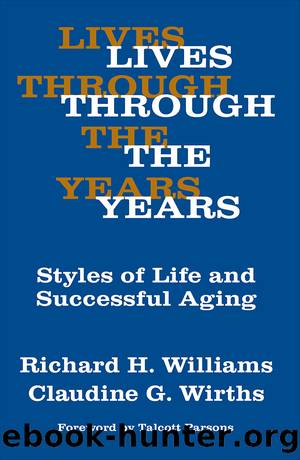
Author:Claudine G. Wirths, Richard A. Williams [Claudine G. Wirths, Richard A. Williams]
Language: eng
Format: epub
ISBN: 9780202309019
Barnesnoble:
Goodreads: 440792
Publisher: Routledge
Published: 2006-12-15T00:00:00+00:00
Forced Disengagement
At the beginning of the study, this sixty-two-year-old woman was living with her husband, who held a semiskilled civil service job. Her one child was married and living in another part of the country.
During the first interview in June 1956, and in many ways throughout the study, she was the most effervescent of all the respondents. Her husband, who was sitting in the background, said of her, âShe just likes to be busy.â She was very active in her church, in Grey Ladies, Red Gross, and in other groups, had many friends, and did a lot of visiting. One group put on banquets to raise money for the church.
In March 1957 we found that her husband had unexpectedly been retired for disability. She cried during the interview, then smiled through her tears and said, âIt isnât so bad, but itâs hard to take; this is our first great trouble.â Later, in an intensive interview by a member of the professional staff of the study, we learned what had happened. Her husband woke up one morning complaining of severe pains in his legs, and was unable to go to work. No organic condition could be determined. The husband completely withdrew into a chronic depression. His co-workers lured him back to work on the pretext that they were shorthanded, but that did not last long. In her perception he had changed radically overnight.
At the beginning of this period she reported watching television more, which she said was âterrible,â and having less company. Her daughter was having a third child. In August 1957 she said she was just fine, but continued to be worried about her husband. She could not get him to go out as he used to. The daughterâs baby was born a spastic. She said she felt about forty-five. There was almost no un-happiness in her lifeââThere could be but I just wonât let it.â In February 1959 she was again âjust fineâ and reported that her husband was somewhat better. âI go to bed and get up singing about it.â They sat up until midnight now and watched television, and then slept late. If her husband did not have to lie down so much, she reported, she would have loved having him at home. She said the best years of her life were from 1931 to 1941. when teen-agers were in and out of the house; the worst were from 1956 on, with her husbandâs illness. She felt something like a widow. In November 1959 she had dropped out of one of her clubs because it involved couples and her husband would not go. In May 1960 she reported being lonely fairly often, and said she was not satisfied with her present mode of life. In March 1961 her daughter and daughterâs family had visited and decided to put the spastic child in a home. She tried to arrange an interview with the husband at this time, but the husband refused. By August 1961 she had given up Grey Ladies, but was still active in many things, especially the church.
Download
This site does not store any files on its server. We only index and link to content provided by other sites. Please contact the content providers to delete copyright contents if any and email us, we'll remove relevant links or contents immediately.
Spell It Out by David Crystal(36117)
Life for Me Ain't Been No Crystal Stair by Susan Sheehan(35811)
Cecilia; Or, Memoirs of an Heiress — Volume 1 by Fanny Burney(32558)
The Great Music City by Andrea Baker(32019)
Cecilia; Or, Memoirs of an Heiress — Volume 2 by Fanny Burney(31956)
Cecilia; Or, Memoirs of an Heiress — Volume 3 by Fanny Burney(31942)
Professional Troublemaker by Luvvie Ajayi Jones(29662)
The Secret History by Donna Tartt(19088)
We're Going to Need More Wine by Gabrielle Union(19046)
Twilight of the Idols With the Antichrist and Ecce Homo by Friedrich Nietzsche(18632)
All the Missing Girls by Megan Miranda(16028)
Cat's cradle by Kurt Vonnegut(15355)
Pimp by Iceberg Slim(14507)
For the Love of Europe by Rick Steves(14121)
Bombshells: Glamour Girls of a Lifetime by Sullivan Steve(14075)
Talking to Strangers by Malcolm Gladwell(13370)
Norse Mythology by Gaiman Neil(13365)
Fifty Shades Freed by E L James(13241)
The Social Justice Warrior Handbook by Lisa De Pasquale(12190)
